Showing posts with label GI Joe. Show all posts

Tuesday, March 04, 2008

Star Wars Helmet Tutorial

I'm not hugely into 1/6th Star Wars figures. I have a few, but not many. But I know there are tons of Star Wars fans, collectors, and customizers out there, so I'm passing along a couple methods of producing removable helmets for Empire troops.


The first is pretty straight-forward. The starting point in this case is a Hasbro TIE fighter pilot, though this technique would probably work for other Hasbro troops such as the storm-trooper, sand-trooper, clone-trooper, and maybe even Boba Fett or Darth Vader.

The figure shown is in fact just a thrift-store special I found nude. As you can see, the Hasbro TIE pilot is mounted on one of those awful Action Man/Hall of Fame bodies. I don't much like the proportions on these, or the lack of articulation (especially the lack of ankle rotation and head tilt).


One option on improving one of these figures is simply to remove the head and transplant it to a GI Joe body of your choice. The head-posts are completely compatible. Of course, you still have to contend with transplanting the molded glove-hands and the sewn-on costumes, but it's doable. But you're still stuck with a non-removable helmet, and that bothers me. Besides, maybe you just want a helmet to sit on a shelf or table in a diorama. So lets turn that TIE fighter "head" into a helmet.

First step is to remove the head. I used the "boil and pop" method. Dip the head into a pot of boiling water to soften the rubber, the pry it gently off the neck post. A narrow tool like a small screwdriver is very helpful in this task.

Take great cautions not to scald yourself, as the hot water likes to find its way inside the hollow head and cavities of the bodies and arms, then dribble out on you as you're working on the figure.

Here's the bottom of the removed head. You can see the opening for the figure's neck post. You can also see a ridge around the bottom of the helmet that probably represents where the real helmet ended. I chose to use that as my cut line. I've heard of people using Dremel moto-tools to cut these, but that's huge overkill. The head is soft vinyl and not very thick. I used a brand-new hobby-knife blade, and it cut like butter.

Again, use caution not to slip and cut yourself, or to cut too far into the helmet. Slow and gentle pressure is the way to go.

Here's the bottom of the helmet. The opening is plenty big for almost any kind of 1/6th figure head.

Here's the finished helmet shown on a molded-shirt CC-Joe with a WW2 head. If anything, this helmet is over-sized.

Our next project is much more challenging. Our starting point is a Burger-King kid's meal toy. These were out a year or two ago, and they aren't hard to find on eBay, or for that matter, at thrift stores and garage sales. There are a couple other figures in this line that might also provide useful helmets (I think there was a Clone Trooper and a Boba Fett, for instance).

The toy is a solid molded figure held together with those damned security screws (triangular openings in the head) that are on so many fast-food toys. (If anyone knows a source for an affordable driver to fit these, please tell me about it.) There's a light mechanism inside activated with a button on the backpack.

Since the helmet is molded as part of the whole, the first challenge is to cut it off. This would be MUCH easier if you could take the figure apart first, but lacking the right tool, and not wanting to take the time to try and drill the screws out, I just started cutting.

A Dremel tool probably would be useful here, but I don't use mine much, and I wasn't confident I could avoid cutting too much, especially in the complex little curves around the "jaw" of the helmet. So I opted for one of my favorite tools, a razor saw. I just took a lot of time and patience going round and round the helmet, coming at the joint line from all angles and taking away a bit of plastic at a time. It was tricky, but I got it done.

Here's the bottom after I cut it off. First problem, the neck opening is way too small. Second problem, the head is full of STUFF, including the LED light and battery holder. I used small needle-nosed pliers to break the tabs holding the light in and removed it. I then was able to work a small pair of diagonal-cutting pliers inside from the bottom and cut the post that contained the screw. This weakened it enough I was able to rip the two halves apart. Again, the right tool for the job would have made this so much easier.

Here are the two halves of the helmet. All the interior junk needs to go. I attacked it using two different sizes of diagonal cutters to "nibble" plastic interior parts out, and a pair of needle-nosed pliers to grab, twist, and break off what was left. Again, patience is required. Again, a Dremel tool would be an option, but be careful not to cut or grind through the outside shell.

Here's what I was left with. A Dremel probably would be the best way to enlarge the bottom opening, but I just sort of whittled things out using a sharp hobby knife, taking away the plastic a sliver at a time. Though I removed all the alignment pins, there's a lip around the edge that makes it easy to put back together properly. I glued the halves together with a bead of super-glue.

Here's the finished helmet on a CC Joe. This is a much tighter fit than the TIE helmet, but I had no trouble getting it on the Joe, and even got it on a much larger Power Team head. I think this is rather close to scale, actually. At least it looks right to me.

The nice thing about this is the you can care up plenty of extra Storm Trooper helmets, if you want them for custom projects or to make a squad of troops. Of course, you'll need to come up with armor for them. Since the original 1:1 Storm Trooper armor was made from vacuum-formed plastic sheet, and home vacuum-forming isn't difficult at all, it wouldn't be that hard for somebody to create some molds to mass-produce 1/6th Storm Trooper armor. Combine that with some simple black body suits, and you could crank out 1/6th Storm Troopers by the dozens!

Go on! I dare you! (And send me a set of armor when you're through.)

Friday, December 07, 2007

A CC Joe Spotter's Guide

(Click on photos for full-sized versions)

(Minor revisions made 12/12/07. Typos corrected, sections on hands and "Kung-fu Gimp" edited.)
Though it only ceased mass-market production a few years ago, it seems more mysterious to many people than the original GI Joe body-style first produced in back in 1964. As I was cleaning up a box of CC Joes caught in our recent storm damage (see previous post for details) I saw an opportunity to sort out some of the many variations of the CC Joe body and document them in one place.

Though many people seem to treat CC Joes as being interchangeable except for the different head-sculpts and hair colors, there were actually a huge variety of body versions, some quite distinctive and unusual. The basic CC design had many variant parts, hands, feet, torsos, different arms, and many had unusual coloring and marking variations. Given all the heads, parts, and ethnic variations, I'd guess (and it is just a guess) that Hasbro probably made somewhere between 100-200 distinctly different CC figures over the life of the line, and literally thousands of configurations were possible (and many are available to the kitbasher as well.

This is by no means a definitive guide, and I don't claim to be an expert. I'd welcome input, corrections, and additional information that can be used to expand and improve this post.


Let's start with some basic body types.

The figure at right is a "CC Blockhead," defined by his flat-top head-sculpt. I think this is one of the very early CC figures. He seems to have a somewhat distinctive neckpost, but otherwise his body parts set the pattern for Joes that continue through the life of the line.

The CC Joe was intended as a modern replacement for the vintage style (AKA, "Timeless Collection" or "TC Body.") GI Joe. The original Joe body style continued to be produced (and is still produced today, in GI Joe Collector's Club exclusives, and store exclusives like the recent GI Joe Adventure Team reproductions sold through Wal-Mart and other outlets) and is preferred by old-school collectors. But the CC body was aimed at younger collectors and kids, who wanted more realism, posability, and durability than the vintage body provided. The CC body was also likely much cheaper to produce with less hand labor, a body designed for modern mass production.

He's got the original gripping hands. I think these are known to collectors as "lobster claws" (correct me if I'm wrong here, guys). Unlike the original GI Joe hard-hands, this Joe could hold his weapons and gear. In some respects, these were more like the Adventure Team Kung-Fu grip hands, but they were larger (too large, some would say), more realistically sculpted, and the fingers were molded together. The design of the hands and arms still had some shortcomings. Joe could hold his rifle, but not in a shooting pose. He also lacked a trigger finger. Later hand variations would address these problems.

Another big improvement over the original Joe is the hip design. Original Joes can't sit properly because of their ball-and-socket hips. The new design featured a hip piece with wide openings, and a hip joint consisting of two friction swivel-joints mounted in a ball. Joe could sit or kneel in a way vintage figures could not. But the hip-joint had its own shortcoming, possibly a fatal one where kids were concerned. See discussion of the "Kung-Fu Gimp" below.

The figure in the middle is a later model. While the original arms continue to be used in many later figures, new "muscle arms" were added to the line. These have more realistic sculpting, and gave the basic Joe a buff new look. This figure features "Gung-Ho Grip" hands. More on these later.

The figure in the left shows just how tricky CC identification can be. This one doesn't look that unusual. But the unusual gloved hands (these hands weren't used on many other figures, and may even be unique to this one) and the anchor tattoo mark this as being part of the Modern Navy Deep Sea Diver set, one of the last high-end mass-market CC Joes. The torso features interior ballast weights that help the figure to dive using the special gear in the set. It just goes to show you that, when it comes to CC Joes, details sometimes count.


I wasn't sure if I should include this picture, but the arms and legs on this figure are definitely CC, so I'm including it, even though the torso is unique. This is another late entry in the CC line, the talker body, used for Talking Duke, as seen here, and a modern military figure whose name escapes me at the moment. You can see the talk button in the stomach. The head is a soft rubber skin (damaged in this example) over a hard plastic skull with moving jaw, molded teeth and tongue, and fingers that move the upper facial features slightly. Pushing the button opens the mouth, moves the face, and causes the interior electronics to utter a single word. You can "puppet" Duke through a wide variety of phrases by pushing the button over and over.

Because of the talking gimmick, the talker body loses waist and neck movement. The hands on Duke are also unusual, and don't swivel like most GI Joe hand. They only rotate on the ends of the arms. The upper part of what seems to be the glove's cuff is actually a separate plastic band (not removable) that rotates freely above the glove. I don't have one of the military variants, so I don't know if those have the same kind of hands, or more conventional CC hands.


Another common CC variation, added in the later years of the line, is the molded shirt. Molded shirts were almost universally criticized by adult collectors as being unrealistic looking and toy-like (as though GI Joe wasn't a toy!), but they were definitely kid-friendly, saved money on manufacturing, and some of the started to grow on me (I think many of them look great layered under an open jacket or long-sleeve shirt).

Here are the three major shirt types (there is also a "vest" torso and matching sleeve arms, which get their own photo below).

On the left is the most common molded shirt, the molded tee. Though not easily visible here, the shirt has a subtle molded-in fabric weave. The arms appear to be a variation of the muscle-arms. The molding of the shirt is such that it's easily hidden under most uniforms, and as I said, looks good layered under an open shirt or jacket. Many of the tee-shirt figures such as this one had graphics or patches painted on the shirt front, back, and sometimes sleeves. A few figures used just the tee-shirt torso with regular arms (there's an example pictured below in the color-variations section).

The headless center figure features the sweater body and arms. The molded in weave is much more pronounced in this version (some kitbashers have painted these in metallic colors to pass as chain-mail). The sweater sculpt doesn't hide under cloth uniforms as well as the tee, and the arms lose some range of elbow movement. (The particular body pictured is from a Sinbad animated movie figure, a couple of which were inexplicably grafted onto the GI Joe Adventure Team line.)

The figure on the right is an "Agent Faces" from the Valor vs. Venom line, and has the "wifebeater" shirt torso. This is an excellent variation for the layering effect I mentioned above. Great for "tough-guy" kitbashes.


This shot shows some of the many types of color variations seen in the line. The Venom figure on the left doesn't have a "shirt" torso or arms. He's got a regular torso, arms, and neckpost molded in red. Likewise his hands don't used a special glove mold. They're just "lobster claw" hands molded in black.

The center figure is a what Hasbro calls an "ethnic" figure. Specifically, this is a Hispanic Joe, identifiable by its slightly darker skin-tone. Hasbro also made African American, Asian, and Native American figures through the course of the line, all with distinctive skin-tones.

The guy on the right shows how Hasbro really mixed parts, and colors on various figures, especially later in the CC line's history. He uses the tee-shirt torso, regular arms, a variation of the lobster-claw hands with molded half-gloves painted to match the shirt, and a color molded pelvis to provide underwear.


These next two guys have what I call "wetsuit bodies." No special parts. These are basically base-line CC Joes with bodies molded completely in color.


This is the final evolution of the "molded shirt." I call it the vest torso, and it was created with a new "sleeve" upper arm mold, with which it was often used. The vest torso was bulky and over-sculpted, with a Peter Pan collar. which the tee-shirt sleeve had been tight and form fitting, this one was sculpted into a wide cuff. These was no hiding this monster under a uniform shirt, and it remains my least favorite common variation on the CC type.

Here you see the variety of ways in which Hasbro employed the mold. On the left, the sleeves and torso get an elaborate paint scheme to represent a body-armor combat vest over a contrasting uniform shirt with rolled-up sleeves.

The center figure has the sleeves and vest painted in matching colors, apparently to represent something like a safari jacket.

Finally, the headless right on the right uses the vest torso with regular arms for a much different look.
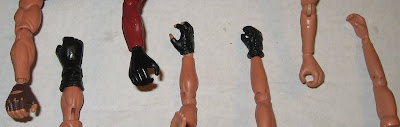


Here are just a few of the many, many variations of hands used on CC figures. There are other types, and many color and paint variations. Almost all early figures have flesh-toned lobster-claw hands, but many other hand types would follow.

The most important variation is the "Gung-ho Grip" hands mentioned above. These are smaller and more realistic than lobster-claws, and have hinged fingers that allow them to pose and hold small objects. They also have a separate trigger finger, and a special up-down (rather than left-right) swivel on one wrist that lets the figure hold a sighted rifle for the first time in GI Joe history. Despite their many advantages, the fingers were loosely jointed and so couldn't support the figure's weight, and in fact, often had trouble holding rifles and other heavy accessories.

Late in the line, a single command0 figure was released with "rope-climbing" hands. These had jointed fingers much like the GHG hands, but they were spring loaded. I've never seen these but most people who have them spoke well of these and wished they had been available on more figures. The spring-loaded GHG might have been the near-perfect GI Joe hand, and a lost opportunity for Hasbro and collectors everywhere.

Let's identify the hands pictured. On the left is a variant of the lobster-claw hands with molded-in half-gloves.

Next is the "Duke" gloved hand.

Next is a lobster-claw molded in black

Center is a Gung-ho Grip hand with molded in half-gloves.

Next is the Modern Navy Diver Glove.

Next is a basic lobster-claw in flesh-tones.

The final hand is a rarely seen version used on some high-end collector figures. I think these are known as "flipper hands." They're small, have unusually long wrists, and don't hold most accessories as well as the lobster-claw hands. I think the intent is that sleeves with more tightly fitted (and therefore more realistic) sleeves will fit over them.

I'm including this picture simply because I didn't spot a nude figure with these unusual gloved hands. I call them "hard gloves." They're bulky, with index fingers sculpted in an extended position. Unlike most Joe hands, they hard, and the fingers don't flex much, if at all. They have long cuffs (mostly hidden here by the sleeves) and heavily sculpted folds and wrinkles in the fabric. These are used in various colors on various fire and military figures as hazmat or flame-resistant gloves.

This Snake-Eyes figure is pictured for one unusual feature. It uses the modern version of the Kung Fu Grip hands. Like the vintage KFG, the modern version has individually molded, flexible, fingers. The fingers are also sharply hooked to allow the figure to easily hang from objects or slide down a rope. Mostly these were used on modern Adventure Team figures (most of which used the updated Super-Articulated, or "SA" GI Joe body, which isn't covered in this post). But unnoticed by almost anyone, a heavily advertised Snake-eyes vs. Storm Shadow two-pack was offered in huge numbers late in the CC line. Both figures had CC bodies, and both had the modern KFG hands molded in black rather than flesh tones. Adventure Team kitbashers, take note. Zillions of these figures were made, and they're common on the secondary market.


CC Joes had two major types of feet. The original style, shown in the middle, seems to be modeled on the vintage style-GI Joe foot. It's larger and has the backwards pointing heel (probably designed to keep the original hard-plastic boots in place).

Many later figures have the "baby foot" design shown at left. These have a smaller, narrower foot, and no heel to speak off. They're necessary for some smaller footwear, more compatible with rubber boots, and are probably make it easier for kids to remove and replace footwear.

The "green baby foot" feet at right may not be a variation at all. My suspicion is that they may have started out flesh toned, but some defect in the plastic mix caused them to turn green when exposed to UV light (probably sunlight). I've seen such "greening" on other body parts when exposed to the sun.


These final two figures do illustrate a couple of other variations in the CC line. Note the chest-tattoo on the figure at left. Many figures had tatoos on the chest or arms. The figure at right has camouflage stripes on the arms (and on the face, but mainly we're talking bodies in this post) and unusual hands. These are standard lobster-claws, but rather than molding them all in black or all in flesh, they seem to have been molded in black and then had the upper parts painted flesh-town to create "shorty-gloves." These look kind of strange to me, so I don't really know what they were thinking.

But the major intent of this picture is to illustrate the most outstanding flaw in the CC body design. I call it the "Kung-fu Gimp."

My observation comes from having purchased or examined many hundreds of used CC Joes in thrift stores, garage sales, etc. A fair number of them, probably well over half, arrive there with their legs and sometimes lower-torsos, reversed as you see here above.

To understand why, you have to look at the design. It's easily possible to reverse the hip ball accidentally. Once that happens, it isn't obvious (without removing the pants for examination of the joint) how to correct the problem. It's far easier to twist the knee, foot, or even waist 180-degrees in an attempt to compensate. Then consider that most modern kids didn't dress and redress their Joes as we baby-boomers did. Most of them played with their Joes just as they came from the package. The kids never saw the leg joints, and so had little hope of understanding how the joints properly worked. (In fact, I just noticed that in the very first picture in this post, the Navy Diver figure on the left is sporting Kung-Fu Gimp as well. It's subtle, and easy to miss even on nude figures unless you're looking for it, or unless you try to pose the figure.)

Combine this with the fact that Hasbro almost always packaged Joes with an odd sideways twist to one leg. Removing the Joe from the package, the child (or sometimes the adult) would attempt to straighten the leg, and it wouldn't work properly. Usually one hip joint would end up flipped. Sometimes the entire torso would end up twisted around and the feet reversed. But the end result was that for the Joe's entire play-life, his legs would be twisted from their proper position. In particular, one leg usually ended up with "gimped" hip and knee joints. For those kids, Joe never posed or moved as he should, and that must have been frustrating. Since, despite us adults, the majority of Joes needed to sell to children in order to make GI Joe a mass-market success, this has to have hurt the line.

Okay, it's a tragic flaw in a great and under-appreciated action figure body. While it lacked the nostalgia value of the Timeless (and later 40th Anniversary) bodies, or the elegant posability of the later Super Articulated body, the CC body was the literal backbone of the modern GI Joe line. They were produced in countless variations by the millions. They were rugged, attractive, more flexible than the vintage-style Joes, and cheap to make.

Though few if any CC Joes are being made any more, they still exist in countless numbers, and likely will continue to exist far in the the future. Consider that if your child reaches middle-age and in a fit of nostalgia decides to track down the 12" GI Joe he knew as a kid, it will probably be a CC Joe that he or she is looking for...

Thursday, December 06, 2007

Joe Sleeps with the Fishes

Over on my regular blog, in the posts here and here, you can read about the recent storm that turned my section of the world into an official disaster area, and how I got off relatively easy by only having a storage shed blown to bits. Lots of Joe stuff in that shed, but my wife and I got most of it out before any real damage was done. One box I intentionally left behind was a big box of nude CC Joes. I figured they could stand the water, and what was left of the shed needed ballast.

By 2AM the night of the storm, the roof of the shed had blown off, and the crate of Joes was exposed to the elements. As it was a flip-top box, it wasn't water tight from above, and it started to fill with rain.

So I dragged the box onto the porch to drain it and dry the contents so they could be brought inside. There was a lot of water. It was clean water though, and CC Joes are tough. In fact, since many of these were thrift store finds with price tags still attached, the soaking actually helped me easily remove a ton of the sticky tags.

Though the box was empty by this point, the condensation inside showed a clear water line. Even though it missed most of the storm and was only in the rain for a couple hours, it had an even four inches of water in the bottom. Not sure how much rain we got total over the course of a day, but I'd say it was probably over twice that much! Of course, places down the coast got up to 12 inches in just a few hours, so it could be worse. We traded rain for 125 MPH wind, and I have a ruined shed to show for it.

But Joe. Joe is a survivor.

Friday, July 27, 2007

Comicon 1 Hasbro

(Lots of photos. Click on them for bigger versions.)

I'm currently in California working on a project and taking a few days to go to Comicon. Actually, two well seperated days, Thursday and Sunday. I've never been to a Comicon before, but this year we had other reasons to head south, and my wife Chris is up for the "Scribe" award for best young-adult media tie-in book of the year for her ALIAS novel, "A Touch of Death." So we decided to come down for the award ceremony (which is on Sunday) just in case she won.

I've never been to a Comicon before, so this was a way of putting our toes in the water, and learning enough to plan a full-on assault next year (or some future date, anyway).


Okay, if you've never been to a San Diego Comicon, you just can't comprehend how BIG this place it is, how many people are there, or how intense it is. I've been to five or six World Science Fiction Conventions, but they're a drop in the bucket compared to this. It isn't just the number of people, but the number of exibitors, the amount of stuff going on, the SIZE of the exibits, or the sheer volume of money, and stuff to be swapped for money, going around.

The above shot is looking the length of the exibit hall from pretty near the MIDDLE. There's almost as much stuff behind the camera as in front of it. This is looking south, towards the end of the hall where the major comic, toy, game, and media companies are located. Behind me are book publishers, comic dealers, toy dealers, swag dealers, cartoonists, and a zillion other things.


This is another shot looking across the floor. This place is geek heaven. It just feels like EVERY possible fannish thing you might possibly desire is out there somewhere. There are toys and statues of every description, clothing, jewelery, art, original comic pages, collector comics, magazines, books, hats, candy, you name it. The only problems: A, finding what you want, and B, finding enough money. Okay, there's also C, how the hell to get it out of there and carry it home. Parking is a huge problem (we parked at Qualcomm (sp?) statium and took a trolley the rest of the way to the convention center. Good for parking purposes, bad for hauling stuff. We only picked up three things, a "King Kong" 1/6th scale "V-Rex" skull (a steal at $15), one of the new-issue Perfect Body Females (Minions need women!), and a con-exclusive "vanishing cream" Bugs Bunny action figure. I had a cocktail thing with the Conan Properties folks that afternoon before leaving, so I didn't want to get too loaded down with stuff. I'll probably buy more on Sunday.


I didn't really see half the exibit floor, and of what I did see, we rushed past most of it. I did try to take a LITTLE time in a few key places, mainly the Hasbro and Sideshow booths. Sideshow was huge, with a ton of 1/6th stuff, with other goodies ranging from statues to full-sized prop replicas. I tried to photograph most of the 1/6th stuff, but I'm not going to try and post it yet. Maybe tomorrow. Maybe when I get home. But I am posting all the Hasbro stuff I have so far.


The GI Joe section was a pretty tiny part of a very large display. Transformers (note the large, fiberglass, Optimus Prime out front), Marvel, and other properties (most of which didn't interest me as much, if at all) got a lot more space.

There was at least a little 12" stuff on display. They had the Wal-Mart AT Joes lined up (which makes a pretty cool display), the Club member figure (which I already have, of course), and the box and a sea sled from the next convention set, photos below.


I don't know if the sea sled was vintage, a prototype, or the real production item, but it was sure clean and nice to see there. The box looks great. No giant veggie-clam on display yet. Sigh.


The rest of the Joe display was three double-sided glass cases. Sigma-6 and 12" shared one case. They had the S6 adventure sets on display, but I was disappointed the Joe Colton one with the vintage-style AT head was not on display.


Significantly, 3 3/4" stuff got two full cases. I don't know if they're making announcements about an RAH movie at this Comicon, but I would not be suprised.


If Joe, in all his forms, is in decline, then lets hope there is a movie. If it doesn't suck (and after Transformers, I don't think anybody isn't going to give it their best effort), then it could really give the brand a HUGE shot in the arm. Yeah, I'd rather see an Adventure Team movie, but if RAH will see the brand, GO JOE!


There was quite a bit of 12" Marvel rotocast on display (what Toy Biz called Marvel Icons, but the one box on display was marked Marvel Legends, just like the smaller figures). I've picked up a couple of these (Iron Man and Dr. Doom, plus I have all the 12" FF movie rotocasts) and I like them a lot. Some of these (like Thor) appear to be previously released figures, but there were several that were new to me.
Here you see Thor, Colossus (he IS colossal!) and Dark Phoenix. Good to see more female figures.


Here you have a brown and tan costume Wolverine (his best costume, IMHO short jeans and a brown leather jacket), Magneto (this didn't impress me as much as the others for some reason), and yellow costume "vintage" Daredevil.


Here we have red-costume Daredevil, Cyclops, Nightcrawler (I liked both the X-Men), Silver Surfer (I liked this one a lot, note his big, two-piece board for packaging purposes), regular Phoenix, and "flamed-on" human torch.


Another shot showing the packaging of a "flaming on" human torch variant, Daredevil and the two X-Men again.


Finally a shot of that whole shelf. Note the smaller 6" Legends figures on the shelf above for size comparison.


Finally, along with the Marvel license, Hasbro also has the license for the upcoming "Iron Man" movie, and they had a few actual props on display. Of most interest were a couple of very detailed prop boots. From the looks of them, these either represent part of Tony Stark's first prototype armor, or the under-construction interior of an incomplete suit. Either way, cool.


Sideshow photos (and anything else I take of interest on Sunday) to follow when I get time. Tomorrow busy, Sunday is Comicon again, and then two days to drive home and who knows how many to sleep this all off.
Sunday, February 12, 2006

Angry Joe Day entry, Jeff Goff


Here's one from Jeff Goff. The Dragon reference cracks me up, never a bad thing.

By the way, a reminder with any of these picture posts that you can click on the small picture in the post to see the full-sized shot (where available). If you aren't doing this, the text in some posts may be darned hard (or impossible) to read, and you may be missing out on some really cool details. So if it catches your eye, you haven't seen the whole picture until you give it another click.

Sunday, January 15, 2006

30th Joe Updated

(I posted this message with an error that I've since corrected. I said this was a 35th anniversary Joe, which didn't sound right. Checking, I see that It was a 30th anniverary Joe, and have made the correction. These were released before I got back into collecting, and I don't even remember seeing one at retail.)

First of all, if you've a mind, scoot over to my "public" writing blog and check out the newly-unveiled cover of my upcoming MechWarrior book, "Trial by Chaos."

And we'll get back to rocket Joe shortly. But first...

Over on the Sandbox, Patrick Stanton posted some photos of his transplant of a 50th Anniversary Target Joe (just to be clear, "50th" in this case is the 50th Anniversary of WWII, not of Joe) head onto a BBi 3.5 body.


This is my own transplant, don't a month or so back, of a 30th Anniversary (of Joe, not WWII, but essentially the same head and body as the 50th) head onto a Mattel Max Steel "Ultra Action" body. I like this body a lot. It's rugged, reasonably posable (it has double jointed elbows and knees, and unlike a standard Max body, the ankles rotate)body that takes a beating and holds poses well. On the down-side it has a molded-in wrist communicator, a non-standard neck mount, and large, rather unrealistic hands. But over all, I nice body, and I've had good luck collecting lots of them in thrift stores over the last couple years.

As it turns out, the non-standard head-mount on the Max is very similar to the one used on the 30th Joe. As I recall, all I had to do was enlarge the hold in the base of the head to fit the Max neck-post.

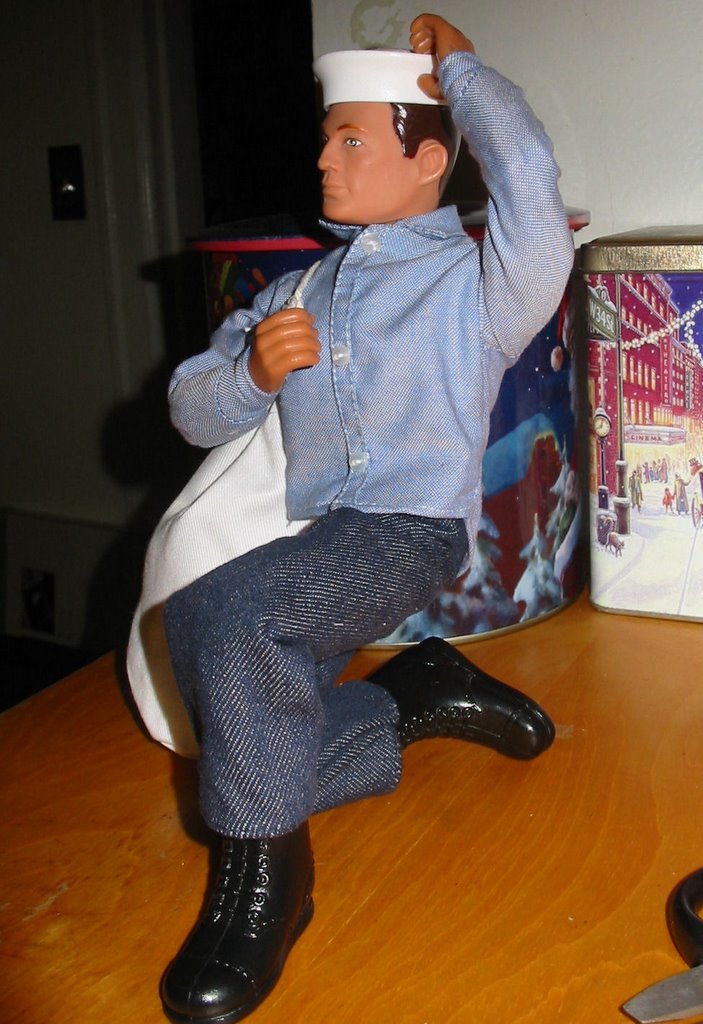
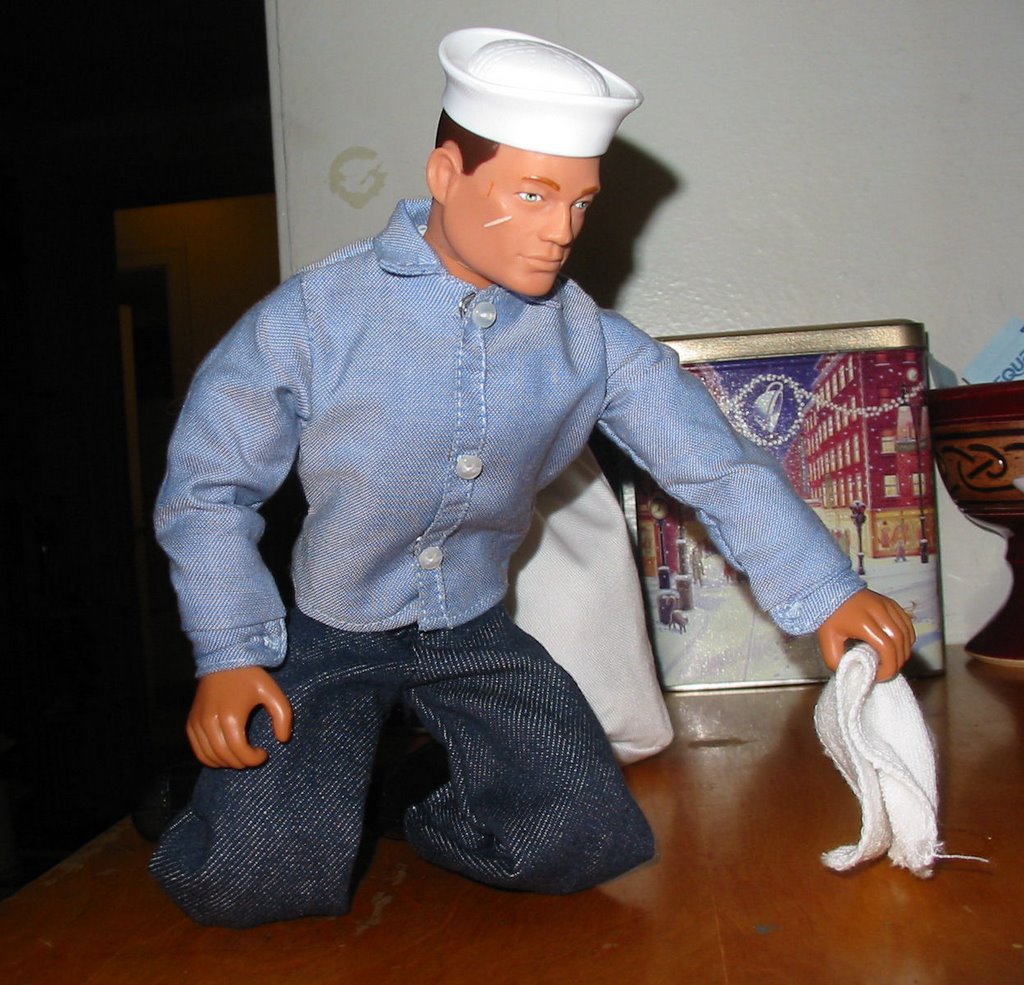
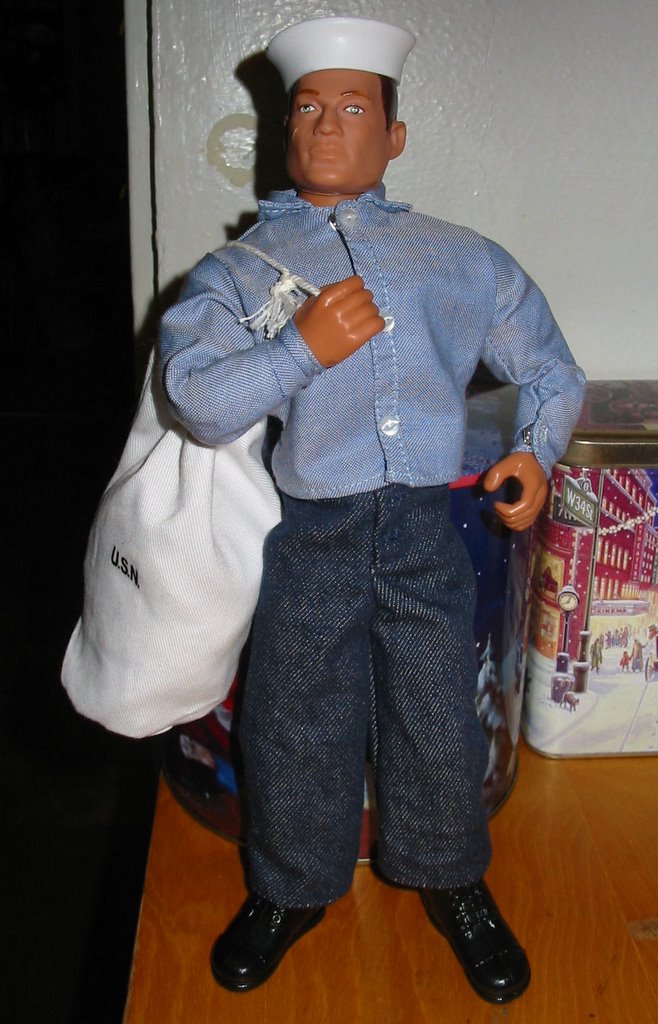
The uniform and accessories here are 40th Anniversary Joe. The spare sailor uniform was just what I happened to have on hand, so I put it on for fit. The snap-cuffs neatly hide the wrist gizmo, and unlike the BBI body, the Max arms aren't too-long for the sleeves on a vintage/TC/40th uniform. The cuffs were tight, but they fit, and the boots are loose (an easy fix, and not a problem at all for display). Overall, I thought the fit of the uniform was surprisingly good.


Now for the good, part. This Joe can do things that no vintage-style Joe ever could.

I confess, even as a child, I was never a fan of the vintage-style body. My first Joe had a stress crack when I got it home from the store. It was frustrating that he couldn't kneel or sit properly. And don't get me started on those "nose-picker" hands. I always thought they looked terrible, and what good is a soldier who can't hold his gun?

As a kid, Captain Action took over most of Joes uniforms and gear (with our two paint-head Joes becoming his supporting players). At least CA could hold a gun.

Well, so can my improved 30th Joe. He can also kneel and crouch and sit.


Of course, from this Joe's perspective, increased flexibility may not always be a good thing.

Swab that deck, sailor!

Monday, January 02, 2006

Bomber Jacket Mystery Art

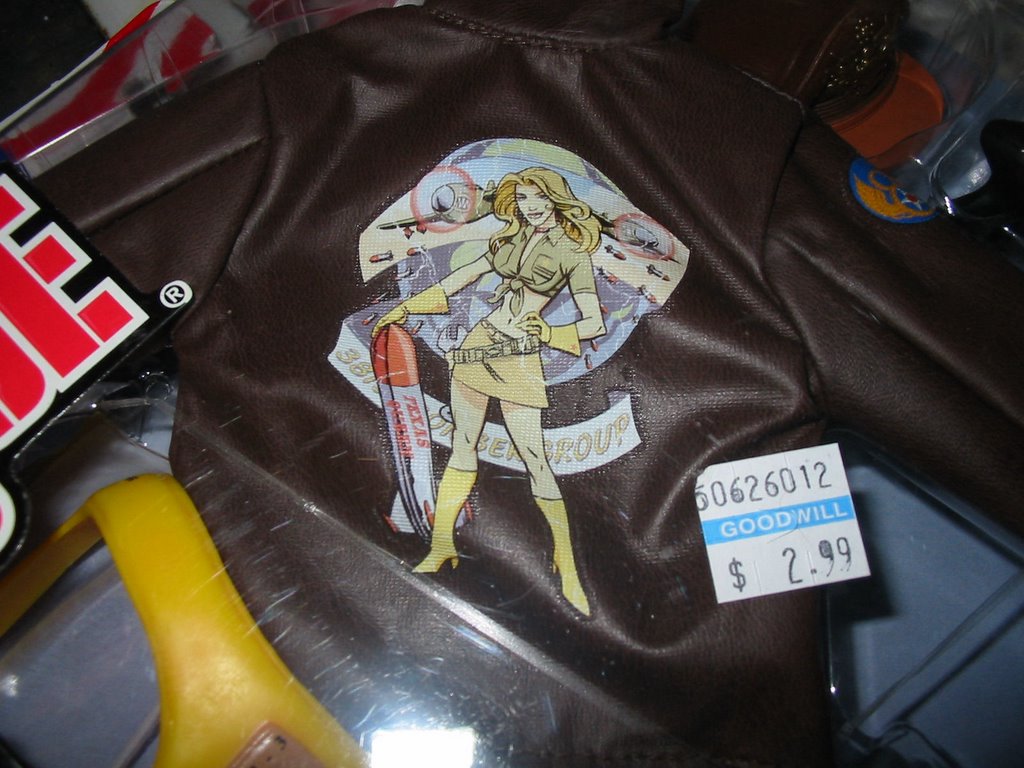
I just stumbled across an unopened Hasbro "B-17 Bomber Mission" carded set at Goodwill today. A nice and unusual find there, and this
version jacket I didn't get when it was out in stores. I think there were two or three different jacket paintings sold in this set. The others were
authentic WWII (in fact, I've seen the actual jacket one of them is based on in the Air Force Museum at Wright Patterson), but this one
looks wrong. The style of the art doesn't seem WWII, but much later.

It looks to me like 70's vintage comic book art. The style of clothing on the "bomber girl" also looks 70s.

The art features a blonde woman with long hair, standing with feet apart. She has a mini-skirt, tight mid-calf boots, "cow-girl" cuff gloves, and a shirt tied under her breasts "Daisy Duke" style. She's holding the end of a bomb in her right hand, which is balanced on its
fins next to her. The bomb says "Texas Queen." A couple of WWII-looking single-engine fighters (they look vaguely like Mustangs, but no belly scoops, and they have "Flying Tiger" type teeth painted on the noses) are flying over her shoulders dropping bombs.

A curved banner behind her legs and the bomb is partially obscured and either
says 381st Bomber Group (which is a real WWII bomber group) or maybe 387th Bomber Group (which doesn't turn up any hits on Google).

Given that the art on the rest of this series was authentic, it seems strange if Hasbro just had an artist make this jacket art up. I consider it more likely that it's based on a real jacket, though
possibly not one from WWII. Of maybe my eye for art is just failing me, and this is just ahead of its time.

Does anybody know the story on this jacket art?

Wednesday, December 28, 2005

Back in the Hangar


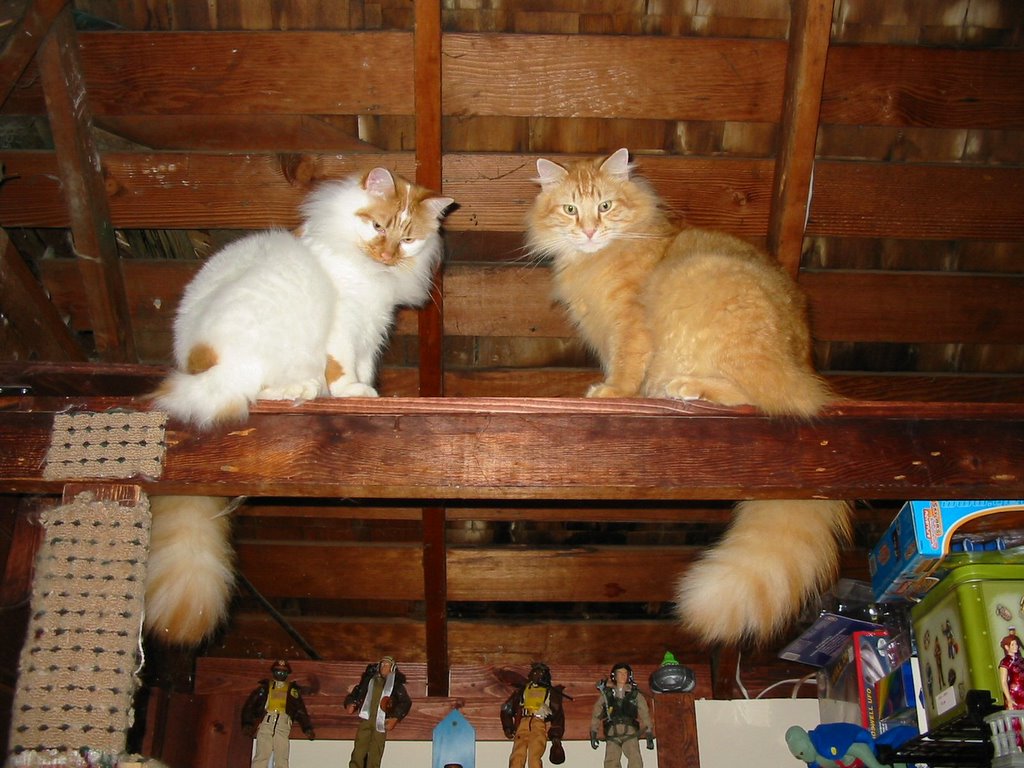
Sorry I've been slacking off on posting these last few days. I'm still dealing with serious health issues with one of our cats, Banzai. (He's the yellow-and-white guy on the left in this picture, the other guy being Oz.) He been off food and we weren't sure he was drinking. Two trips to the vets and about $300 later, we're making progress. He's hydrated again, and actually ate a couple of kitty-treats out of my hand this evening, the first solid food I'm aware that he's touched since before Christmas. So I'm hopeful that we'll get him eating again, and back on the road to health.

Okay, so this picture is relatively free of 1/6th content, it isn't completely free.

The picture is taken in my office, a converted 1943 garage I call "Hangar 18" after the mythical hangar of UFO lore where the remains of a crashed UFO and its pilots are kept. I left the ceiling unfinished because I liked the rustic look, and any added woodwork was stained to match the reddish color of the 60-plus year-old cedar. Among the added woodwork is a "cat bridge" along the top of an existing wood rafter that the cats were using anyway, and the cat-ladder on the left, which extends from the beam to the office floor. Just off-camera up and to the right is an opening into the semi-connected house attic. The cats can leave my wife's attic office, go through the attic, and come down the cat ladder in my office.

Considering that the office is my primary GI Joe display area, it's a good thing that both cats are pretty-well behaved about my collectively. They usually stay off tables and shelves, and rarely knock things over. An especially worrisome display is the shelf of pilots right behind the cats. What you can't see in the picture is that this isn't a normal shelf (see picture below). It's a hand-carved replica of the front of a WWII B-17 bomber, produced by a local craftsman (since retired for health reasons, this was one of the last ones he made). It's a beautiful piece, and great for displaying GI Joes, but it's only supported by two screws in the back of the fuselage, so any "wing walking" by the cats would be disastrous.

Tempting through it must be, though, none of the cats have ever bothered it. Let's hope it stays this way, as this is one item in my collection that is literally irreplaceable.

Wednesday, December 07, 2005

Goodwill Hunting


Okay, so by the calendar, I missed a day. But given that I posted twice on each of the two previous days, I don't consider myself too off-course. Now, on to business...

I have a hard time driving past a thrift store. It's an especially good time to visit them now, with one-sixth action figures harder to find in stores, and their popularity with kids well past the last peak, it's easier to find GI Joes in Goodwill than Wal-Mart these days.

I've been finding lots lately. Mainly I find nude or partially dressed figures, CC Joes, some SA Joes, and other figures of interest like 21st Century guys and "Super-Action" body Max Steels.

It's rare to find a completely dressed figure, much less a completely equipped one, but this guy I found yesterday comes close.

I consider him one of my "best-ever" Goodwill finds. Not only is this a Joe that I wanted, and missed at retail, but he's all (or nearly all) there. Price (you can still see the tag on his chest), $2.99.

Now, to shop regularly at thrift stores is to be both a archeologist, and an anthropologist, studying among the ruins of late 20th, early 21st century western civilization. After a time, you start to notice things. Actually, I think it would be most instructive for toy designers to study thrift stores, searching for clues as to what children keep, and what they discard, how they play with toys, and how they break them.

What can we learn from studying this amazingly intact specimen?

1. It was almost undoubtedly played with by a child. Though he didn't love it to death, it also wasn't (as is sometimes found) an unwanted gift, taken from the box but otherwise hardly touched. I like to think it was loved enough to be taken care of well (thus its intact accessories), but possibly the child played with for a while and then lost interest.

In any case, this contradicts the idea that the high-end, more realistic GI Joes went only to adult collectors. I'll attest from the bits and pieces I find, the kids usually get them too.

2. The left arm joints were all twisted around backwards. I find this (or some variation of "twisted limb syndrome") on almost every dressed Joe I find at a thrift. The kids can't figure out how those hidden joints work beneath the clothing, and they get them twisted around. I remember this frustration with my own childhood Joes. It's a problem that goes back to the original body style.

Note that this doesn't happen with "super-action" Max Steels, as the joints are designed differently than Hasbro bodies, and are nearly kid-proof despite the double knee and elbow joints. Hasbro never quite got that right.

3. The oxygen tank was obviously removed and replaced. It seems like the shoulder straps may have come out of the buckles, and the child couldn't figure out how to replace them. So he strapped the tank on upside-down, hanging down the leg. This is almost logical, and kind of looks cool. I've since refixed the tank on his back, but having struggled with the buckles, I understand the kid's frustration.

4. Note the thing in the figure's left hand. I believe this is a projectile from a Spider-man figure, and this is strong evidence that the child actually played with the figure. It also shows that kids still mix-and-match their toys. What did it represent to the child? Was it a tool, a weapon, a torch, or a flashlight? We'll never know, but in these pre-fab-out-of-the-box times, any shred of young creativity I can find gladdens my heart.

How did Joe end up at Goodwill? Also impossible to know. Maybe the family moved. Maybe mom cleaned the kids room and threw out "extra" toys (don't you hate it when moms do that?). Maybe the child outgrew the toy, or even lost it somewhere.

We can't really know. All I can say, is Joe is safe now, and will be well cared for. Someday, when I'm not around any more, the toy will move on. And maybe someday, when that kid is 40 or 50, that kid will remember that long-lost toy with a nostalgia and longing.

And maybe, if he is very lucky, he can have it back.